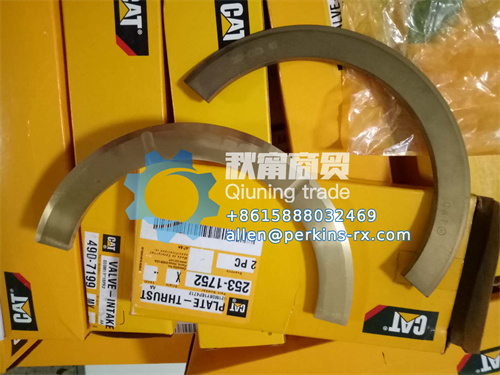
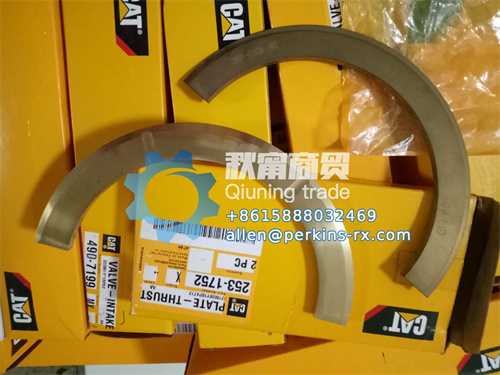
The "Axial stability Guardian" of the crankshaft system - Caterpillar 3406 engine thrust plate 253-1752
In the engine crankshaft system, the thrust plate is the "key fulcrum" that controls the axial displacement of the crankshaft, and its performance directly affects the fit accuracy and wear rate of core components such as the crankshaft and cylinder block. Caterpillar 253-1752 thrust plates, with "original factory-level precise matching" and "working condition-based design" at their core, have become an important guarantee for the stable operation of heavy-duty equipment. Their core value lies in the deep integration of "axial positioning" and "load resistance and wear reduction".
1. Original factory Compatibility: Eliminate the risk of "axial movement"
As an original part of Caterpillar, the thickness, curvature and positioning protrudes of 253-1752 are perfectly matched with the crankshaft thrust surface and cylinder block bearing housing of the 3406 engine (for specific compatible models, please consult customer service). The surface profile customized through the original factory 3D scanning technology ensures that the fit clearance with the crankshaft thrust surface is controlled within 0.03-0.05mm (avoiding excessive clearance causing axial movement of the crankshaft and too small clearance causing friction and jamming), so that the axial load of the engine is evenly distributed under conditions such as gear shifting shock and rapid acceleration. Eliminate the "abnormal wear" or "positioning failure" of the universal thrust plate caused by adaptation deviation from the source.
Ii. Materials and Craftsmanship: Hard power to Cope with Extreme loads
It adopts a composite structure of high-tin aluminum alloy and steel back
The surface alloy contains 15% high-tin content, has moderate hardness and self-lubricating properties, and its friction coefficient is 20% lower than that of ordinary cast iron. It can form a stable oil film when the crankshaft rotates at high speed, reducing direct metal contact.
The high-strength steel back at the bottom layer is heat-treated and strengthened, with a tensile strength of over 900MPa. It can withstand the instantaneous axial impact force (over 5 tons) during frequent engine starts and stops and heavy load climbing, preventing the thrust plate from deforming or breaking.
The "micro-pit oil storage design" on the surface increases the lubricating oil storage space by 40%. Even when the cold start oil is not fully lubricated, it can still reduce wear through the pre-stored oil film, making it particularly suitable for operation in low-temperature environments.
This design enables the thrust plate to have a 50% longer lifespan than OEM parts in the "pulse load" scenarios where construction machinery frequently changes direction (such as the bucket movement of excavators) and commercial vehicles frequently shift gears.
Iii. Detail Design: Ingenious Protective ideas Hidden in the "Oil Tank" and "Edge"
Spiral oil groove layout: The annular oil groove on the surface of the thrust plate guides the engine oil to evenly cover the friction surface, increasing the heat dissipation efficiency by 30% and avoiding the risk of erosion caused by local overheating.
Edge chamfering treatment: The edge of the thrust plate undergoes an arc transition to reduce the resistance of oil flow, lower the possibility of impurity retention and accumulation, and indirectly protect the cleanliness of the lubricating oil circuit.
Precise engagement of the positioning boss: It fits tightly with the boss groove of the cylinder block bearing housing, preventing the thrust plate from shifting during high-frequency vibration and ensuring the axial positioning remains stable at all times.
Iv. "Systematic Protection" for Engines
The stable performance of the thrust plate actually builds a "multi-layer protection chain" for the engine:
Crankshaft extension: Uniform load-bearing reduces wear on the thrust surface, extending the crankshaft major overhaul cycle by more than 25%.
Vibration suppression: Precise positioning reduces the axial movement amplitude of the crankshaft, improves the smoothness of engine operation, and reduces noise by 12%.
Interlocking protection: It avoids secondary faults such as connecting rod deformation and piston eccentric wear caused by the failure of thrust plates, reducing the overall maintenance cost.
Choosing original factory thrust plates is essentially a "preventive investment" in the core transmission system of the engine, especially suitable for construction machinery with extremely high reliability requirements (such as loaders and bulldozers) and commercial fleets.
Maintenance suggestions: It is recommended to check the condition of the thrust plates during major engine overhauls or every 200,000 kilometers of maintenance, with a focus on observing whether there are scratches, peeling or abnormal wear on the surface. When replacing, the bearing housing should be cleaned by a professional technician. Tighten the bolts in stages according to the original factory torque to ensure uniform force distribution. If abnormal noise or increased vibration of the engine is detected during daily use, the condition of the thrust plate should be checked in a timely manner.
Caterpillar 253-1752 thrust plate redefines the axial positioning standard with "original factory precision" and "load-bearing design" - it is not only a supporting component, but also the "axial guardian" for the stable operation of the engine. From material selection to detail refinement, every design aspect is empowering reliability under extreme working conditions. Choosing the original factory thrust plate means adopting a maintenance strategy of "low wear and long service life", ensuring that the engine always maintains the precision and smoothness of the crankshaft system during heavy-load journeys.